Food Safety Temperatures for Food Handlers
Updated July 30, 2026
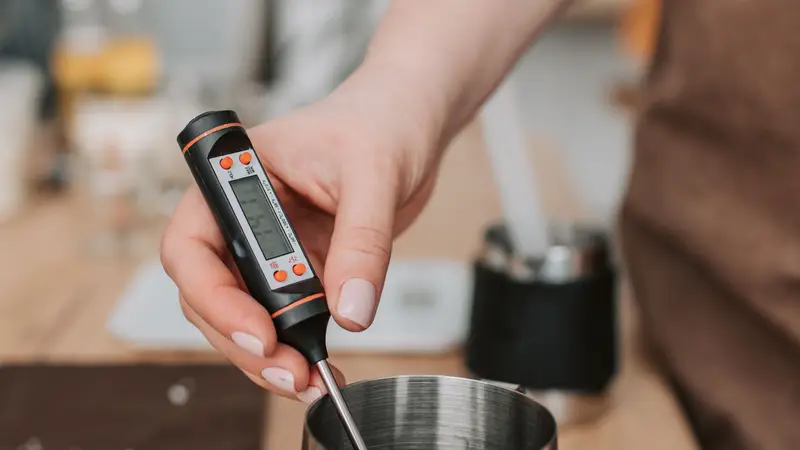
Most food-safety temperature rules fit on one mental map: cold at 41°F or below, hot at 135°F or above, and cool cooked food fast. The specific cooking temperature depends on the food.
This guide uses the 2022 FDA Food Code, the latest full FDA edition as of July 2026. The Food Code is a model: your state, county, tribal, or local health authority adopts and enforces its own code. Use this as a dependable training reference, then follow the stricter local rule or your establishment’s approved procedure.
The temperatures worth memorizing
| Task | FDA Food Code baseline |
|---|---|
| Cold-hold TCS food | 41°F or below |
| Hot-hold TCS food | 135°F or above |
| Cook poultry, stuffed foods, stuffing, and wild game | 165°F or above, instantaneous |
| Cook ground/non-intact meat, comminuted fish, and eggs not for immediate service | 155°F for 17 seconds |
| Cook intact meat, fish, and eggs made to order for immediate service | 145°F for 15 seconds |
| Reheat cooked, cooled TCS food for hot holding | 165°F for 15 seconds within 2 hours |
| Cool cooked TCS food | 135°F to 70°F within 2 hours; 135°F to 41°F or below within 6 total hours |
The cooking rows come from Food Code §3-401.11; the holding, reheating, and cooling rules come from §§3-501.16, 3-403.11, and 3-501.14. The Code includes additional time-and-temperature combinations for roasts, so use the full chart rather than this quick reference for roast cooking.
What “TCS food” means
You will hear TCS constantly in food-handler training. It means time/temperature control for safety food: food that needs time and temperature control to limit pathogen growth or toxin formation. In a working kitchen, think cooked rice, meat, poultry, fish, dairy, cut melons, cooked vegetables, and prepared dishes—not every food in the building.
The practical point is not to memorize a giant list. Know which foods on your station need a temperature check, and check the food itself—not merely the air display on the cooler or steam table.
Cooking: choose the right target
The Food Code requires a time as well as a temperature for most raw animal foods. A reading of 145°F is only the right answer when the food is held there for 15 seconds and belongs in that category.
- 145°F for 15 seconds: intact meat and fish; eggs broken and prepared to a customer’s order for immediate service.
- 155°F for 17 seconds: ground or otherwise non-intact meats, comminuted fish, and eggs not prepared for immediate service.
- 165°F, instantaneous: poultry, stuffed fish/meat/pasta/poultry, stuffing containing animal food, and wild game.
For microwave cooking of raw animal foods, the Food Code calls for 165°F throughout, stirring or rotating, covering, and a covered two-minute stand time. A package bearing manufacturer cooking instructions should be cooked according to those instructions before it is used in ready-to-eat food or served unpackaged.
Holding: keep food out of the middle
For TCS food, the FDA Food Code baseline is 41°F or below for cold holding and 135°F or above for hot holding. That range in between is often called the “danger zone.” It is not a magic line that makes food unsafe on contact; it is the temperature range where control of time becomes essential.
That is why a steam table is for holding, not for bringing a pan of cold leftovers up to temperature. Food that was cooked and cooled and will be hot-held again must reach 165°F for 15 seconds within two hours. Commercially processed, packaged ready-to-eat TCS food has a different reheating target—135°F for hot holding.
Some operations use time as a public health control instead of temperature control for a specific food. That is a written, monitored procedure under Food Code §3-501.19—not an informal decision to leave food out. Ask the person in charge before relying on it.
Cooling: the rule behind the rule
Cooling is where a lot of otherwise careful kitchens lose control. The FDA’s two-stage rule for cooked TCS food is:
- Cool from 135°F to 70°F within 2 hours.
- Cool to 41°F or below within 6 total hours.
Reaching 70°F early gives you the remaining portion of the six-hour total—not a fresh six hours. Food prepared from room-temperature ingredients, such as reconstituted food, has a four-hour path to 41°F or below.
The Food Code lists practical methods: shallow pans, smaller or thinner portions, rapid-cooling equipment, stirring in an ice-water bath, heat-transfer-friendly containers, and adding ice as an ingredient. The method has to work for the actual batch; take and record temperatures according to your workplace procedure.
A thermometer is a food-safety tool, not a prop
Color, texture, and a timer can be useful cooking cues, but they do not prove the internal temperature. Use a clean, suitable food thermometer and take readings at the thickest part of the food, away from bone, fat, or the pan. For thin food, follow your thermometer’s instructions and measure in a way that gets the sensing area into the food.
The Food Code also requires food temperature measuring devices to be accurate within stated tolerances and readily accessible for checking food temperatures. In practice: know where your thermometer is, keep it clean, and tell the person in charge if it is damaged or gives a reading that does not make sense.
Sources and further reading
- FDA Food Code 2022, §§3-401.11–3-401.15 — cooking requirements and manufacturer instructions.
- FDA Food Code 2022, §§3-501.14–3-501.16 — cooling and holding requirements.
- FDA Food Code 2022, §3-403.11 — reheating for hot holding.
- FDA cooling guide for food employees — July 2024 quick reference.
Common questions
What is the food temperature danger zone?
The FDA describes 41°F to 135°F as the range where time/temperature control for safety (TCS) food is most susceptible to pathogen growth. Keep cold food at 41°F or below and hot food at 135°F or above unless your establishment is using an approved time-control procedure.
Does a food thermometer need to go in the middle of the food?
Measure the thickest part of the food and avoid bone, fat, and the pan. For a large batch, take more than one reading. Your establishment should follow the thermometer manufacturer's instructions for cleaning, use, and calibration.
Can I cool hot food by putting a large pot straight into the walk-in?
A large, deep pot may not cool quickly enough. The FDA Food Code lists shallow pans, smaller portions, rapid-cooling equipment, ice-water baths, and ice as an ingredient among effective cooling methods.